
Images of Distinction
Celebrate photographic excellence, explore new creative possibilities, and discover how Images of Distinction can inspire your growth as a photographer. Be Among the Best of the Best.
Round TWO
Open to ASP Members
No commentary day for Round 2
How Images of Distinction Works
Images of Distinction consists of two competition rounds, each offering opportunities for recognition and artistic achievement. Participants may submit up to 12 images in each round.
Open Competition
Round One
Round 1 is open to all photographers, including ASP members and nonmembers. Images are evaluated by a panel of judges, with scores of 80 or higher earning a Seal of Approval and scores of 85 or higher earning a Seal of Distinction.
A dedicated commentary session takes place the following day, offering feedback and insights from experienced judges.
ASP Member Competition
Round TWO
Round 2 is open exclusively to ASP members. Members may enter images that scored 80 or higher in Round 1, as well as new images that have not previously been entered.
Images do not advance automatically. ASP members who wish to carry sealed Round 1 images into Round 2 must select those images and pay the new entry fee before the deadline. Unchanged images retain their original scores, while revised images are judged again.
Round 2 offers additional opportunities for awards and recognition, including Best of Show.
Before You Enter
A few important things to know before submitting your images. Be sure to review the complete competition rules for all entry requirements.
Image Size
Images must be 4000 pixels on the longest side.
Choose Your Category
Explore the competition categories and subcategories to find the best fit for your image.
Retain Original Camera Files
Keep your original RAW camera files, as they may be requested for image verification.
Review Editing Requirements
Understand which adjustments and creative techniques are permitted in your chosen category, and whether supporting guide images are required.
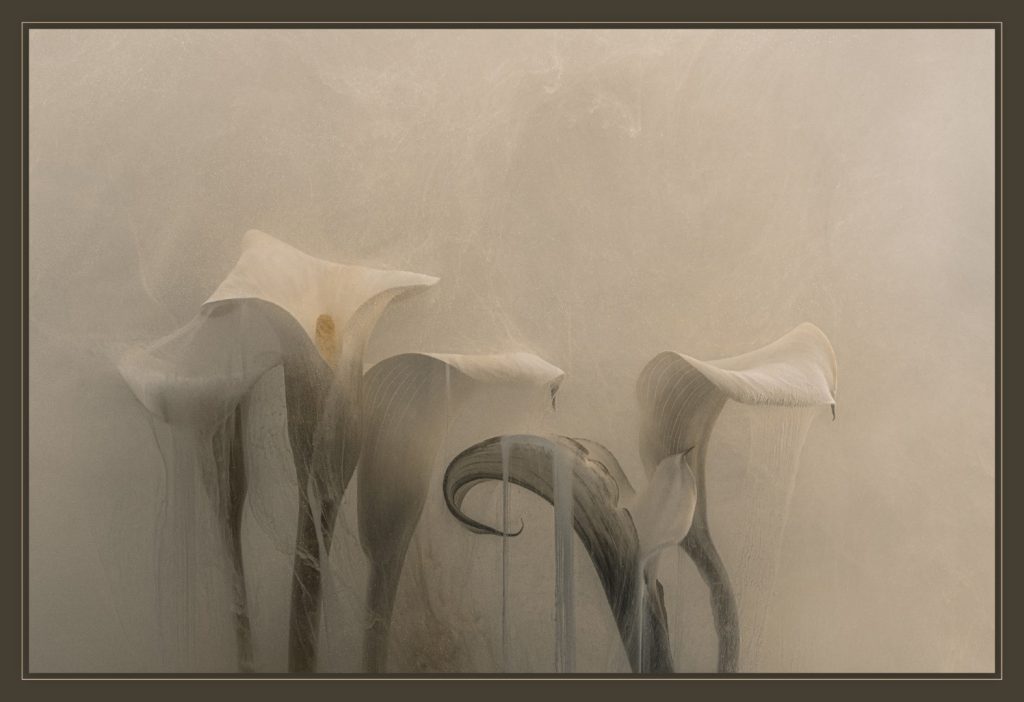
Photo Credit: Kim Norby, Frigid
Competition Categories & Rules
Explore the competition categories and subcategories to find the best fit for your images. Expand each category to review its description, editing requirements, and specific entry guidelines.
Photo Credit: Carly Sullens | Quiet Elegance
RAW
Original native-camera RAW capture with no post-processing. In-camera picturestyle presets, including monochrome mode and similar camera presets, are permitted. The embedded JPEG will reflect those settings and will be used for judging. Creative effects produced during capture, such as long exposure, camera movement, lenses, gels, filters, reflections, refraction and in-camera multiple exposure, are permitted when present in the submitted native RAW file or its camera-generated embedded preview. No post-capture adjustments, retouching, compositing or digital alteration. RAW files converted to JPEG, TIFF, PSD, DNG and other second-generation files are prohibited.
For judging, the IOD RAW Conversion Committee extracts the camera-generated embedded JPEG from the submitted RAW file, including any in-camera picturestyle presets applied at capture. No additional presentation is permitted.
Photojournalism
Images must authentically document actual events, circumstances, or moments of human, cultural, social, historical, or public interest. Entries must tell a meaningful story visually without requiring explanatory text. Subjects may include breaking news, sports, street photography, community activities, cultural traditions, humanitarian issues, and everyday life. Images must not be posed, staged, directed, or recreated by the photographer. Images made as coverage of weddings, quinceañeras, religious ceremonies, milestone celebrations, or similar personal or social events belong in Events, including candid coverage. Unrelated, independently observed public documentary moments are evaluated according to their actual subject and context.
Permitted corrections are cropping, straightening, exposure, white balance, contrast, color correction, sharpening, noise reduction, black-and-white conversion, and reasonable dodging, burning, and saturation adjustments. Cropping or tonal editing must not conceal contextual information so as to misrepresent the event. Cloning and healing are limited to sensor dust and camera-generated artifacts, never actual scene elements. Adding, removing, replacing, relocating, or compositing scene elements is prohibited; only a single capture qualifies. The original RAW or camera-generated JPEG must be available upon request. Edits that compromise factual accuracy, content, or context may result in disqualification. ASP follows the integrity principles of AP, NPPA, World Press Photo, and the Los Angeles Times; these published IOD rules govern when standards differ.
Events
Images captured as part of an actual wedding, quinceañera, bar/bat mitzvah, baptism, milestone, cultural or religious celebration, fundraiser, or similar event qualify, including candid, posed, directed, and detail images. Portraits made as part of scheduled event coverage, including between ceremony and reception and during multiday celebrations, may qualify when clearly part of that event rather than a separate portrait commission. Retouching, compositing, removal, and other alterations are permitted, but the primary subject(s) must be photographed by the entrant during the event; added photographic elements must also be made by the entrant. A replacement sky is allowed only if photographed by the entrant at the same event.
Natural Portrait
Portraits that preserve the subject’s photographed appearance through posing, lighting, expression, environment, and routine processing. Normal makeup, clothing, costumes, props, and styling are permitted, including elaborate costumes photographed in camera. Cleanup and selective retouching, including cloning, healing, patching, content-aware fill, and liquify, may remove distractions or refine clothing and hair but must not substantially reshape the subject’s anatomy, body size, facial structure, or natural appearance. Background cleanup must not create a substantially different scene. Composites, extensive digital transformation, painterly reconstruction, and effects that materially create the image’s concept belong in Artistic Portrait. A costume alone does not automatically make a portrait Artistic.
Natural Portrait Subcategories
Newborn & Babies
Birth through age 1; child is the primary subject.
Children
Ages 2–17 child or multiple children.
High School & College Seniors
Senior in high school or college as the primary subject; traditional, lifestyle, environmental, activity or athletic.
General Portrait
Adults, couples, families, groups and portraits not fitting other portrait subcategories
Pets & Domestic Animals
Domesticated companion animals, working animals, livestock, and non-domesticated species legally kept as personal companion pets. The animal must be the primary subject and may be photographed in a controlled, directed, or natural setting. Non-domesticated animals housed in zoos, wildlife sanctuaries, rehabilitation facilities, or other wildlife exhibits must be entered in the appropriate Wildlife or Wild Animals in Captivity category, based on their living conditions.
Artistic Portrait
Interpretive, stylized, or transformed portraits in which concept, styling, theatrical makeup, compositing, manipulation, or extensive artistic editing is central to the result. Heavily constructed theatrical concepts may qualify even when much of the styling was achieved in camera. All photographic components in the final image must be created by the entrant. The shared Portrait subcategories below apply to both Natural and Artistic Portrait. Newborn & Babies includes one or multiple children from birth through age one; High School & College Seniors includes qualifying graduating students regardless of whether they are 16, 17, or older.
Natural Portrait Subcategories
Newborn & Babies
Birth through age 1; child is the primary subject.
Children
Ages 2–17 child or multiple children.
High School & College Seniors
Senior in high school or college as the primary subject; traditional, lifestyle, environmental, activity or athletic.
General Portrait
Adults, couples, families, groups and portraits not fitting other portrait subcategories
Pets & Domestic Animals
Domesticated companion animals, working animals, livestock, and non-domesticated species legally kept as personal companion pets. The animal must be the primary subject and may be photographed in a controlled, directed, or natural setting. Non-domesticated animals housed in zoos, wildlife sanctuaries, rehabilitation facilities, or other wildlife exhibits must be entered in the appropriate Wildlife or Wild Animals in Captivity category, based on their living conditions.
Natural Illustrative
Subjects and environments must retain the photographed scene’s natural integrity. Basic adjustments, sensor-dust removal, and other strictly technical artifact correction are permitted. Minor cleanup is allowed only when the particular subcategory expressly permits it, and it must not change actual scene elements or their meaning. Cloning, healing, patching, content-aware fill, liquify, and similar tools may not add, move, reshape, or remove actual scene elements. Digital painting, reconstruction, and composites that construct or change scene content belong in Artistic Illustrative. Exposure blending and focus stacking may be used only to combine captures of the same subject and viewpoint without changing actual scene content; refer to the editing matrix and category-specific limits.
Natural Illustrative Subcategories
Landscape & Nature
Landscapes, plants, waterscapes, cityscapes, aerial, macro, astro and other nature-based subjects
Wildlife *
Free-ranging wild animals in natural or substantially natural habitats, including large reserves where they roam freely
Wild Animals in Captivity *
Non-domesticated animals in controlled habitats, including zoos, aquariums, rehabilitation facilities, pens and other exhibits
Open
Still life, transportation, architecture, objects, non-nature macro and other illustrative subjects not fitting another category
* Category is determined by the animal’s freedom and actual habitat, not merely the presence of an outer fence. Animals roaming in large reserves may qualify as Wildlife; those in individual tanks, cages, pens or controlled exhibits belong in Captivity.
Artistic Illustrative
Creative interpretations or transformations of photographed scenes through digital painting, compositing, artistic processing, or substantial alteration. All photographic components of the final work must be created by the entrant. The shared Illustrative subcategories distinguish Landscape & Nature (including cityscapes), Wildlife in free-ranging or substantially natural habitats, Wild Animals in Captivity in controlled habitats, and Open. The animal’s actual freedom and living conditions, not enclosure size or whether humans provide food alone, determine its classification.
Artistic Illustrative Subcategories
Landscape & Nature
Landscapes, plants, waterscapes, cityscapes, aerial, macro, astro and other nature-based subjects
Wildlife
Free-ranging wild animals in natural or substantially natural habitats, including large reserves where they roam freely
Wild Animals in Captivity
Non-domesticated animals in controlled habitats, including zoos, aquariums, rehabilitation facilities, pens and other exhibits
Open
Still life, transportation, architecture, objects, non-nature macro and other illustrative subjects not fitting another category
* Category is determined by the animal’s freedom and actual habitat, not merely the presence of an outer fence. Animals roaming in large reserves may qualify as Wildlife; those in individual tanks, cages, pens or controlled exhibits belong in Captivity.
Commercial
Photography created for or presented in the style of advertising, branding, publication, promotion, or other commercial communication, including fashion/beauty, products, food, architecture/interiors, corporate/industrial, and editorial work. A paid commission is not required. Full post-production, creative composites, and significant manipulation are allowed, subject to entrant-authorship and source-material rules.
Abstract
Photographic artwork emphasizing form, geometry, color, texture, pattern, light, movement, or atmosphere, whether recognizable or fully abstracted. In-camera effects, multiple exposures, extensive digital manipulation, and compositing are permitted, subject to the general entrant-authorship and non-AI restrictions.
Artist
Traditional and digital artwork, paintings, mixed media, and photographic restorations; photography need not be a component. Third-party stock imagery or artwork may be used when appropriately licensed or authorized, but processing, artwork, and rendering must be performed by the entrant. Every entry must include thumbnail guide images documenting source materials and the development of the work. Restoration entries must include the original image and additional process thumbnails. Entrants must be prepared to identify sources and document their rights to use them if requested. Generative AI-created content is prohibited.
AI Fusion
Round 1 Showcase Category Only
AI Fusion begins with a photograph that must be shown as a guide image; the photograph need not have been captured by the entrant. Third-party source imagery and generative AI, prompting, compositing, painting, rendering, and other creative methods are allowed, subject to applicable permissions and rights. Entries receive scores and critiques and are eligible for R1 AI Fusion Showcase Awards. They do not earn ASP seals, Photographic Artistry Award points, Medallion or District Awards, or inclusion in the Best of the Best Collection.
AI Fusion Special Rules
- Every entry must originate from a starting photograph.
- The entrant must have the legal right to use the starting photograph.
- The starting photograph must be included as a guide image with the entry.
- The final image may incorporate AI-generated content and any other creative, digital, or artistic techniques.
- The final image will be judged as a complete work. The guide image is provided for context only and is not scored.
AI Fusion Special Rules
AI Fusion is offered for Round 1 only.
AI Fusion entries are not eligible for inclusion in the Best of the Best book or video, Medallion or District Awards, seals, or ASP Photographic Artistry Points.
AI Fusion entries are eligible for category awards and recognition.
Additional Entry Information
Albums
An album must be entered in the category matching its subject and editing style. Albums present subjects or events that benefit from a sequenced visual story. Each album must comply with the selected category’s subject and editing requirements. Albums must include 5 to 18 spreads, with the opening spread displaying the album title. See the submission specifications in Section 8 for file format and presentation requirements.
Subcategory Award Eligibility
A subcategory with 12 or more entries receives its own award. A subcategory with fewer than 12 entries will be combined with the most closely related subcategory within the same main category for award purposes.
Editing Guide
Editing requirements vary by competition category. Use the guide below to see which techniques are allowed, restricted, or prohibited. Always review the complete category description and competition rules before submitting your images.
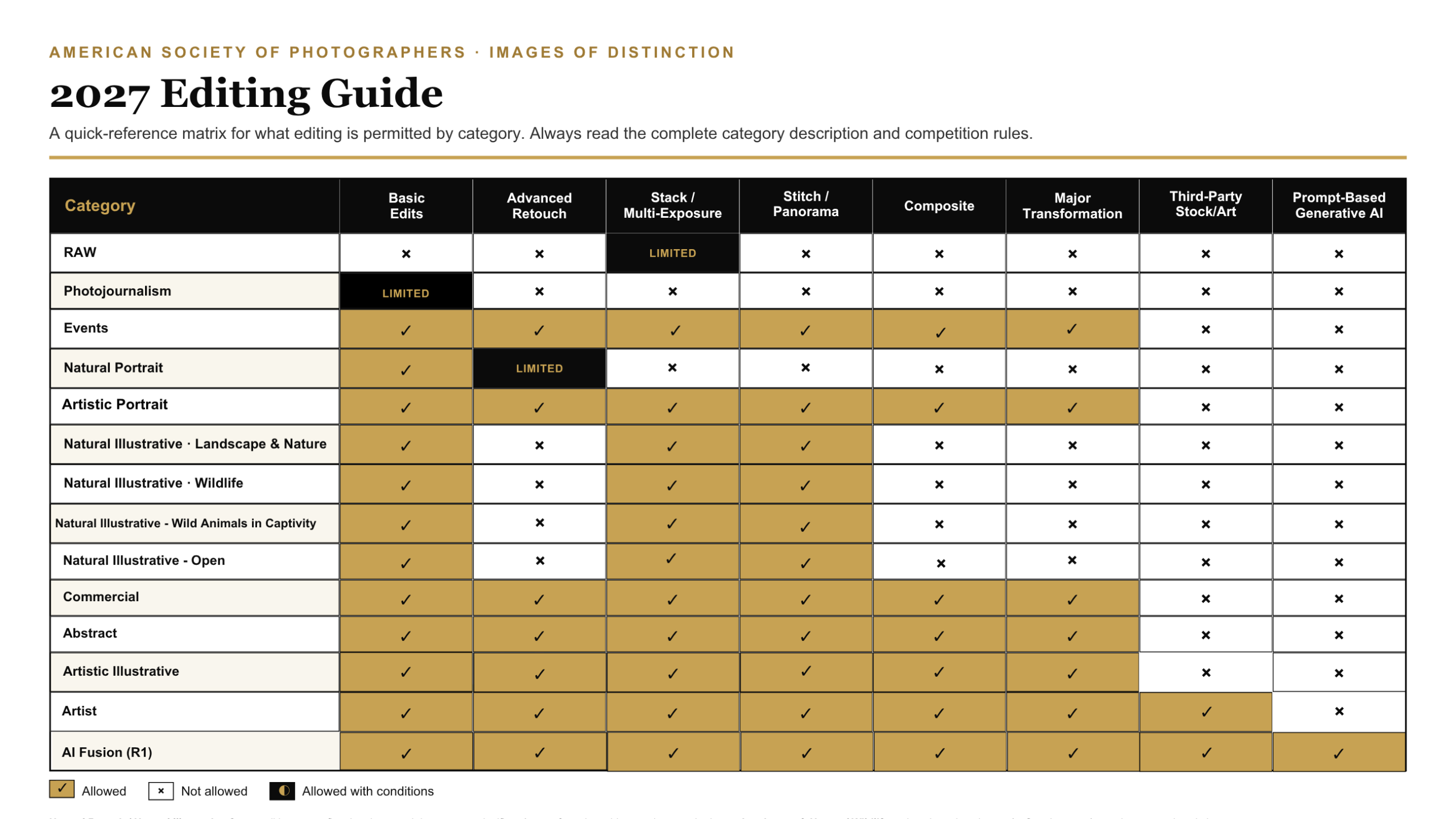
Editing Terms & Definitions
Basic Edits
Cropping, straightening, rotation, exposure and white balance correction, contrast, highlights and shadows, color correction, black-and-white conversion, reasonable sharpening and noise reduction, and dodging or burning. These adjustments must comply with the selected category’s rules.
Advanced Retouching
Cloning, healing, patching, content-aware fill, liquify, and comparable techniques. The allowed extent depends on the category. In Natural Portrait, these tools may be used for limited cleanup consistent with the subject’s original appearance; they do not authorize significant reshaping, background reconstruction, or compositing.
Major Transformation
Adding, deleting, replacing, relocating, reshaping, or materially altering an actual person, animal, object, or other photographed scene component. For example, sky replacement is a major transformation but removing sensor dust spots is not. The category descriptions and matrix together govern whether changes are allowed.
Minor Cleanup
Limited removal of technical blemishes or small distractions only where the category expressly allows it, without altering significant scene content, meaning, or the natural photographed appearance. “Minor” does not permit removing important objects or subjects.
Limited
An editing method is permitted only to the extent specified in the full category description.
Photo Credit: Kimberly Olker | Spiritual Sunrise
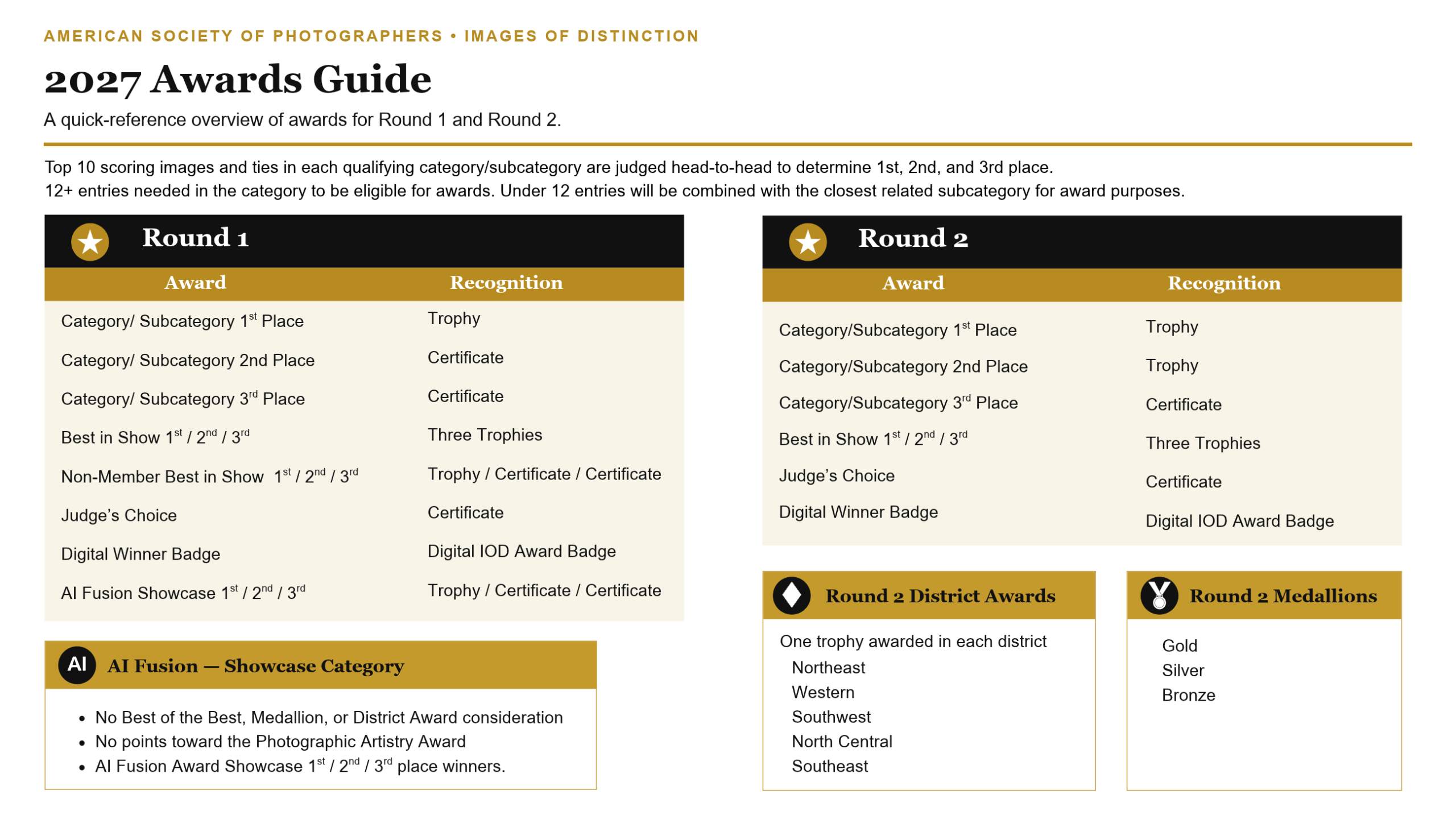
Awards Guide
Discover the awards and recognition opportunities available through Images of Distinction. From category placements to Best in Show, District Awards, and Medallions, explore how photographic excellence is celebrated in Round 1 and Round 2.

Best of the Best Image Collection
Celebrate the artistry and achievements of ASP's Images of Distinction photographers through the Best of the Best Image Collection books.
Each volume showcases exceptional images recognized through the competition, offering a collection of photographic excellence, creativity, and artistic vision.
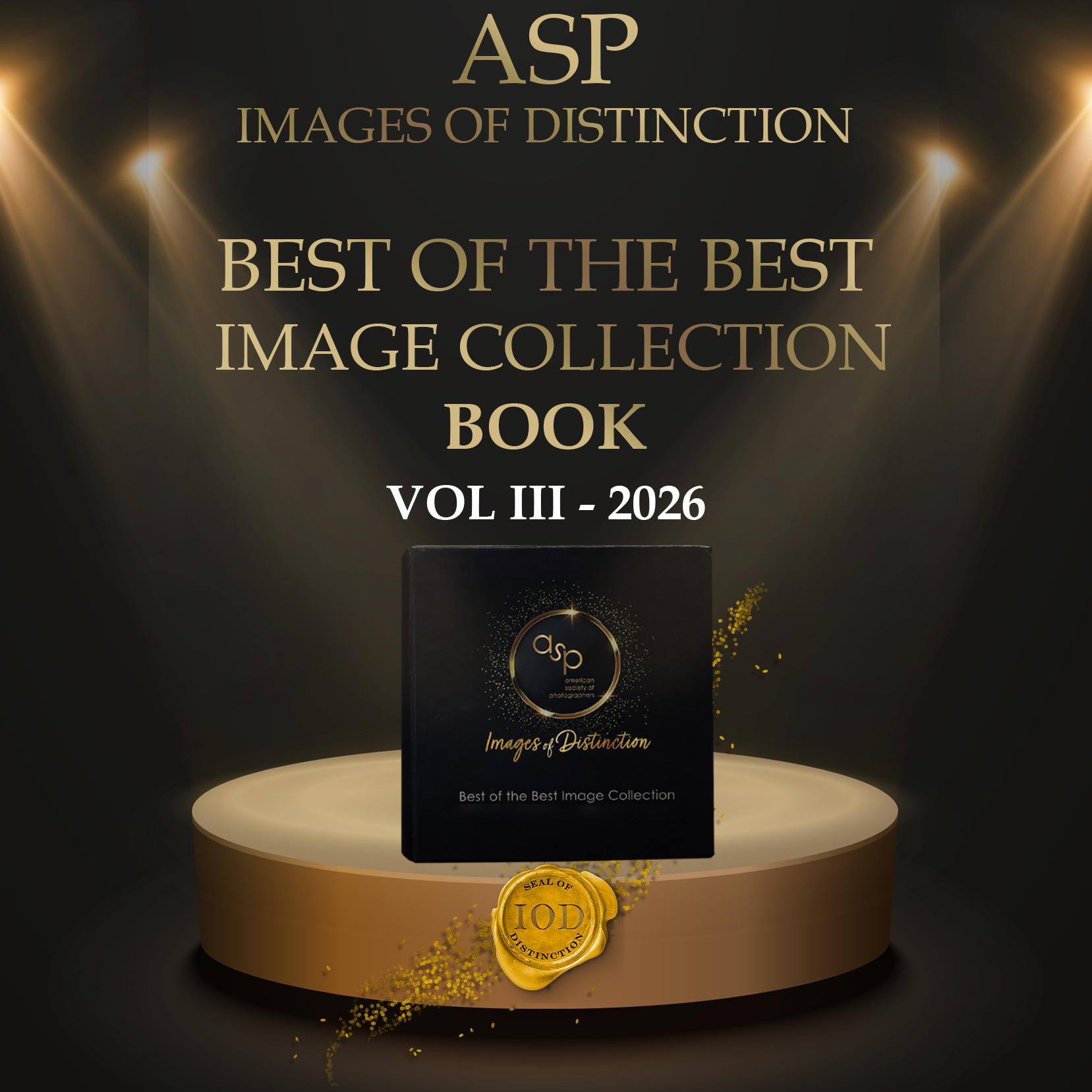
2026 Best of the Best
Volume III - coming soon
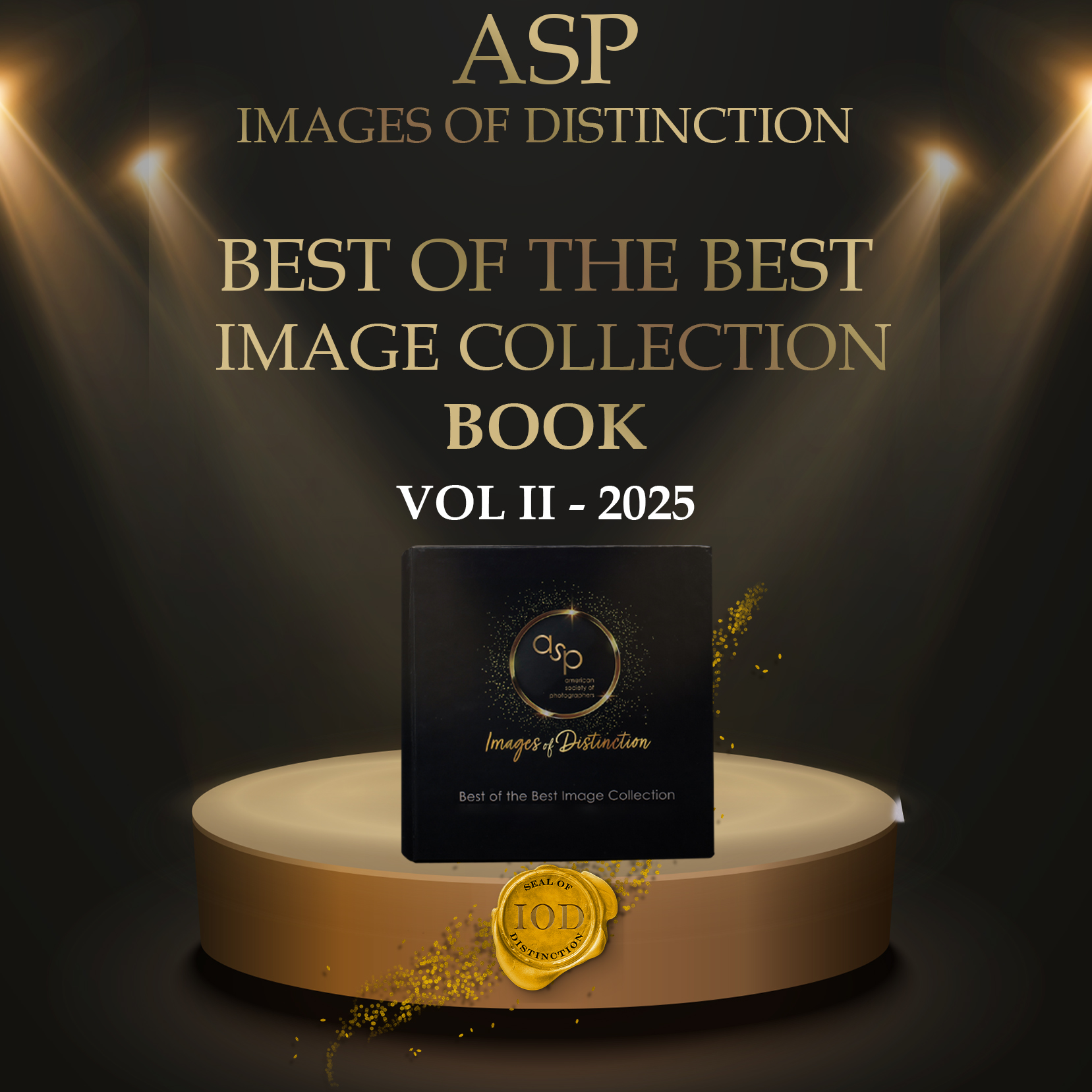
2025 Best of the Best
Volume II
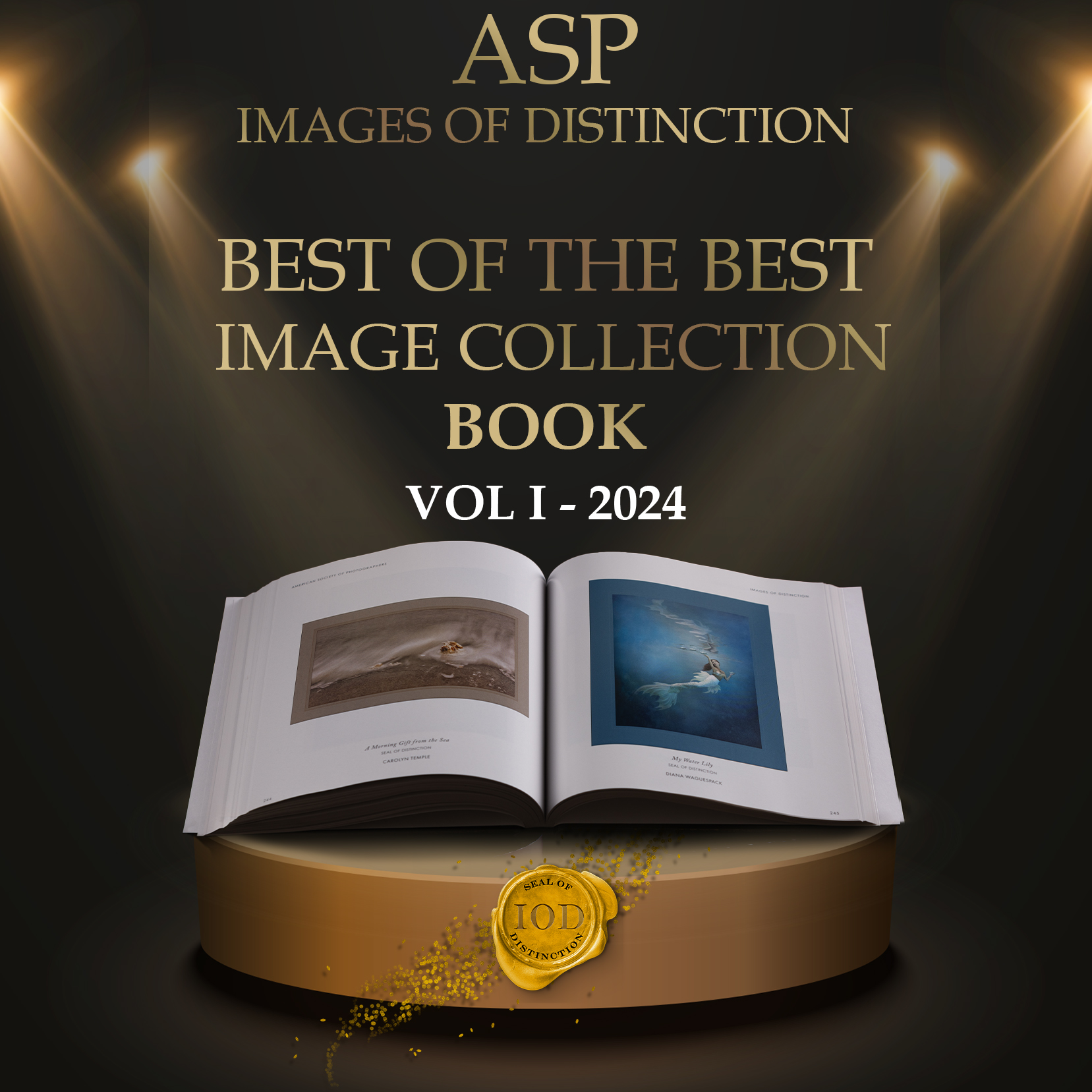
2024 Best of the Best
Volume I
Frequently Asked Questions
Have questions about ASP Images of Distinction? We’ve gathered answers to some of the questions we hear most often to help you prepare for the 2027 competition.
For complete eligibility requirements, category descriptions, editing guidelines, and entry specifications, please review the 2027 ASP Images of Distinction Competition Rules.
Do I have to be an ASP member to enter Images of Distinction?
No! Round 1 is open to both ASP members and non-members. Round 2 is exclusively for ASP members. Non-members can earn eligible seals and compete for designated non-member awards in Round 1.
For additional information, see Section 1 of the official competition rules.
How do I register and submit my images?
All entries are submitted through www.printcompetition.com under the ASP Images of Distinction competition. Both ASP members and non-members may register for Round 1, while Round 2 is exclusively for ASP members.
To enter, create a profile on printcompetition.com, select the ASP Images of Distinction competition, choose the appropriate category, enter your image title, upload your image, and complete payment before the submission deadline. There is no separate “Submit” button required.
For additional information, see Sections 1, 2, and 8 of the official competition rules.
How do seals work, and what are my options for sealed images from Round 1 when entering Round 2?
Images scoring 80–84 in Round 1 receive a Seal of Approval, while images scoring 85 or higher receive a Seal of Distinction. Both recognize images that meet ASP’s standards of photographic excellence.
Eligible ASP members may carry sealed Round 1 images into Round 2 by selecting and paying for those entries before the deadline. If an image remains unchanged, its original score carries forward without being judged again.
You have three options for your sealed images:
- Keep Your Seal: Select and pay for your sealed image before the Round 2 deadline. Your original score carries forward without being judged again, and your image remains eligible for applicable Round 2 awards and recognition.
- Do Not Enter the Image: If you decide not to carry your image into Round 2, simply delete it from your entries. The image and its Round 1 score will not be considered for Round 2 awards or Photographic Artistry Award points.
- Break Your Seal: If you want to make changes to your image, delete the unpaid sealed version and upload your revised image as a new entry. Breaking the seal, whether intentionally or accidentally, means your original score no longer carries forward, and your revised image must be judged again for a new score.
What if I’ve already paid for my sealed image but decide I want to break the seal?
Upload your revised image as a new entry and contact the IOD team at iod@yourasp.org. The team will manually transfer your existing payment to the revised image and coordinate the removal of your original sealed entry.
My sealed images disappeared. What should I do?
If you’re registering around the Early Bird deadline, your sealed images may temporarily disappear while the entry fees are being updated. Give it a few minutes, then refresh your PrintCompetition page. Your sealed images should reappear.
If your images are still missing, please contact the IOD team at iod@yourasp.org with your name and the title of the missing image so we can investigate and assist you.
All changes must be completed before the final submission deadline. Entry fees are nonrefundable.
For additional information, see Sections 2 and 3 of the official competition rules.
What's the difference between Round 1 and Round 2?
Round 1 is open to ASP members and non-members and includes a dedicated commentary session, offering valuable insight into each image’s strengths and opportunities for improvement. Round 2 is exclusively for ASP members and offers the opportunity to earn points toward the ASP Photographic Artistry Award. You do not have to participate in Round 1 to enter Round 2.
For additional information, see Sections 1–3 of the official competition rules.
Can I enter an image that has already earned a merit or award in another competition?
Yes, in many cases! Images that earned a Merit or Imaging Excellence score in PPA’s Merit Image Review (MIR) are eligible. Images entered in IPC in 2023 or later are also eligible, provided they did not receive a Top 32 designation.
However, images selected for the World Photographic Cup, images that merited in IPC before 2023, and images that scored 80 or higher in a previous ASP Round 2 are not eligible. Additional restrictions apply to previously entered ASP images.
For additional information, see Section 4 of the official competition rules.
What's the difference between Natural and Artistic categories?
Natural categories emphasize preserving the original photographed appearance of the subject or scene, with editing limitations that vary by category. Artistic categories allow greater creative interpretation, including extensive editing, compositing, and creative transformations. Dramatic lighting, elaborate costumes, or props do not automatically make an image Artistic. The overall creative approach, including how the image was conceived, photographed, and edited, helps determine the appropriate category.
For additional information, see Sections 6 and 7 of the official competition rules.
Can I enter multiple images of the same person, animal, or subject?
Yes, provided each image represents a substantially different creative concept. Simply changing the pose, crop, lighting, costume, or background may not be enough to qualify as a different concept. This restriction applies even when images are entered in different categories. If you’re unsure, you can request a pre-entry determination from the IOD Committee before the submission deadline.
For additional information, see Section 5 of the official competition rules.
How many images can I enter?
You may enter up to 12 images per round. Round 1 has a competition-wide limit of 1,000 entries, so early registration is encouraged. Round 2 has no competition-wide entry limit, but individual entrants are still limited to 12 images.
For additional information, see Section 1 of the official competition rules.
How do I know which category to enter?
Choosing the right category depends on your image’s subject matter, creative approach, and level of editing. Some images may qualify for more than one category, depending on how the work was created and presented. Review the category descriptions and choose the one that best represents your finished image.
We encourage you to explore the 2027 IOD Category Guide, which provides category descriptions and permitted editing guidelines to help you determine the best fit for your image.
For complete category definitions and editing restrictions, see Sections 6 and 7 of the official competition rules.
Is artificial intelligence allowed in Images of Distinction?
Generative AI-created imagery is prohibited in all regular competition categories. However, Round 1 includes a separate AI Fusion Showcase that allows generative AI. Entries must originate from a photograph and include that photograph as a guide image.
AI Fusion entries receive scores and critiques and may earn showcase awards, but they are not eligible for ASP seals, Photographic Artistry Award points, District Awards, Medallions, or inclusion in the Best of the Best Collection.
For additional information, see Sections 5 and 6.11 of the official competition rules.
What's the difference between a Seal of Approval and a Seal of Distinction?
Images scoring 80–84 receive a Seal of Approval, while images scoring 85 or higher receive a Seal of Distinction. Both recognize images that meet ASP’s standards of photographic excellence. Qualifying ASP member images scoring 85 or higher in Round 2 are included in the ASP Best of the Best Collection and are eligible for consideration for District Awards and Medallions.
For additional information, see Sections 3, 9, and 10 of the official competition rules.
How do I earn points toward the ASP Photographic Artistry Award?
ASP members earn Photographic Artistry Award points through Round 2 of Images of Distinction. Each year, their four highest-scoring qualifying images receiving scores of 80 or higher count toward the award.
Points are awarded based on image scores:
- 80–89: 1 point
- 90–99: 2 points
- 100: 3 points
Additional points may be earned through qualifying ASP awards, including State Elite, District Awards, and Gold, Silver, and Bronze Medallions.
Members may earn a maximum of 12 points per competition year from all eligible sources combined, with no more than 6 points coming from sources outside Images of Distinction.
To receive the ASP Photographic Artistry Award, members must accumulate 30 points, with at least 16 points earned through Images of Distinction Round 2.
Qualifying images from Round 1 may also contribute their original scores, provided they remain unchanged and are entered and paid for in Round 2 before the deadline.
For additional information, see Section 10 of the official competition rules and the ASP Photographic Artistry Award guidelines.